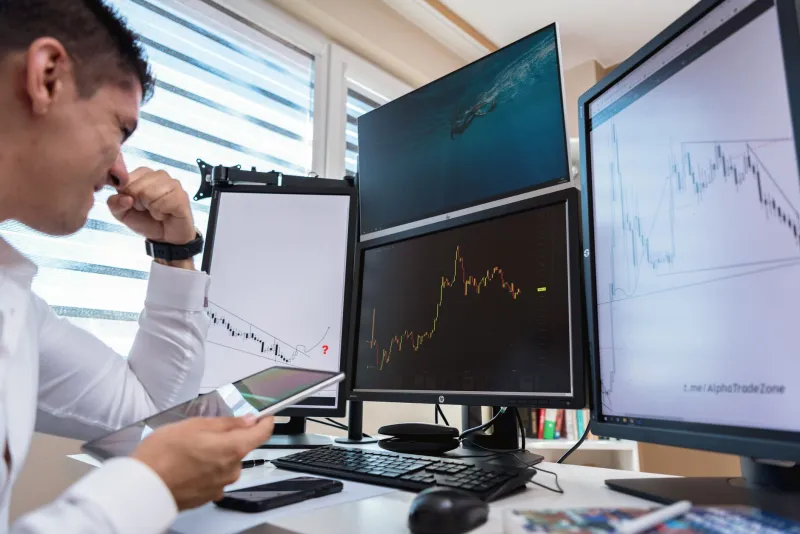
When Having Everything Gives You Nothing: The Hidden Cost of Tool Overload in Retail Investing
The Promise That Doesn't Always Pay Off
The modern retail investor has never been better equipped. Real-time options flow data, AI-powered screeners, multi-timeframe charting suites, earnings whisper trackers, sentiment analyzers — the list of available tools grows longer every quarter. For a platform built on the idea of unlimited access, that abundance feels like the entire point.
And yet, a persistent and uncomfortable pattern has emerged across behavioral finance research: the more tools an investor actively uses, the worse their risk-adjusted returns often become. A 2020 study published in the Journal of Finance reinforced what earlier research had long suggested — increased trading activity, frequently driven by information overload, correlates negatively with net portfolio performance. The average active retail trader underperforms a simple index fund not because they lack information, but in many cases because they have too much of it.
This is the tool overload paradox. Unlimited resources, when applied without discipline, can quietly cap your potential rather than expand it.
Why Abundance Triggers Poor Decision-Making
To understand the mechanics of this problem, it helps to examine what happens neurologically when investors are presented with an overwhelming volume of signals. The human brain is not wired to process dozens of competing data inputs simultaneously and arrive at calm, rational conclusions. Instead, it defaults to a series of well-documented cognitive shortcuts — shortcuts that tend to cost money in a market environment.
Confirmation bias is perhaps the most insidious offender. When a trader has access to fifteen different indicators, they will almost always find several that validate whatever thesis they already hold. The tools do not generate objectivity; they generate ammunition for pre-existing beliefs.
Analysis paralysis compounds the damage. Faced with contradictory signals from a Fibonacci retracement tool, a MACD crossover, a volume profile, and a social sentiment dashboard, many investors simply freeze — or worse, make impulsive decisions to break the deadlock. Neither outcome reflects sound strategy.
There is also the illusion of control, a cognitive bias particularly well-documented in investing contexts. Sophisticated dashboards create a feeling of mastery over an inherently uncertain system. That feeling is seductive, and it tends to produce overconfidence — which, in turn, produces excessive trading, tighter stop-losses, and a reduced tolerance for the short-term volatility that long-term returns require.
The Simpler Strategy Advantage
Consider the performance record of straightforward, rules-based investing approaches. Dollar-cost averaging into a low-cost S&P 500 index fund — a strategy requiring no scanner, no charting software, and no sentiment tracker — has outperformed the majority of actively managed funds over rolling ten- and twenty-year periods, according to S&P's SPIVA reports. This is not a fringe finding. It is one of the most replicated results in modern finance.
None of this suggests that analytical tools are inherently harmful. The issue is not the tools themselves but the undisciplined accumulation of them. A skilled surgeon does not bring every instrument in the hospital into the operating room. Selectivity is part of the expertise.
The same logic applies to building an investment process.
A Framework for Choosing Tools That Actually Matter
Rather than abandoning technology altogether, the more practical solution is to build a deliberate, minimal toolkit — one where each component earns its place by serving a specific, non-redundant function. Here is a working framework for getting there.
Step 1: Define your investment thesis first, tools second. Before selecting any platform or indicator, articulate your strategy in plain language. Are you a long-term value investor? A swing trader focused on momentum? A dividend-income builder? Your thesis determines what information is actually relevant. A value investor has little use for a real-time options flow scanner. A momentum trader does not need a dividend yield screener. Clarity of strategy is the precondition for clarity of tooling.
Step 2: Audit what you currently use — honestly. Most investors who have been active for more than a year have accumulated tools they rarely consult. Open every platform, every subscription, every browser tab that is part of your routine. For each one, ask: In the past 90 days, has this tool changed a decision I made, and did that change improve my outcome? If the answer is no, the tool is noise.
Step 3: Build a core stack of three to five tools with distinct functions. A well-constructed minimal toolkit might include: a reliable fundamental data source for evaluating company financials, a single charting platform for reading price and volume context, a portfolio tracker for monitoring allocation and performance, and an economic calendar for awareness of macro events. That is four tools, each performing a function the others do not replicate. Everything beyond that should require explicit justification.
Step 4: Establish a review cadence, not a monitoring habit. One of the most underappreciated drivers of tool overload is the habit of constant monitoring. When your charting platform is open all day, you will react to it all day. Designating specific times for market review — before the open, after the close, and perhaps once mid-session — reduces the volume of inputs your decision-making process has to absorb. Fewer touchpoints with your tools often means fewer impulsive trades.
Step 5: Measure output, not effort. Finally, resist the temptation to equate analytical effort with investment quality. Spending four hours on a stock screen does not make the resulting pick better than one arrived at in forty minutes with a focused process. Track your actual returns against your benchmarks. If your multi-tool workflow is not beating a simpler baseline strategy over meaningful time periods, that is data worth taking seriously.
Unlimited Access, Disciplined Use
The value of having access to a comprehensive suite of investment tools is not diminished by using fewer of them. If anything, the ability to identify which tools serve your specific strategy — and to ignore the rest — is itself a form of analytical sophistication that most retail investors never develop.
Unlimited access is the starting point, not the finish line. What you do with that access, and how deliberately you constrain it to what genuinely serves your goals, is what ultimately separates investors who benefit from their resources from those who are quietly overwhelmed by them.
The most powerful investment decision you may make this year is not which new platform to add to your workflow. It might be which three you finally decide to remove.